I. Introduction
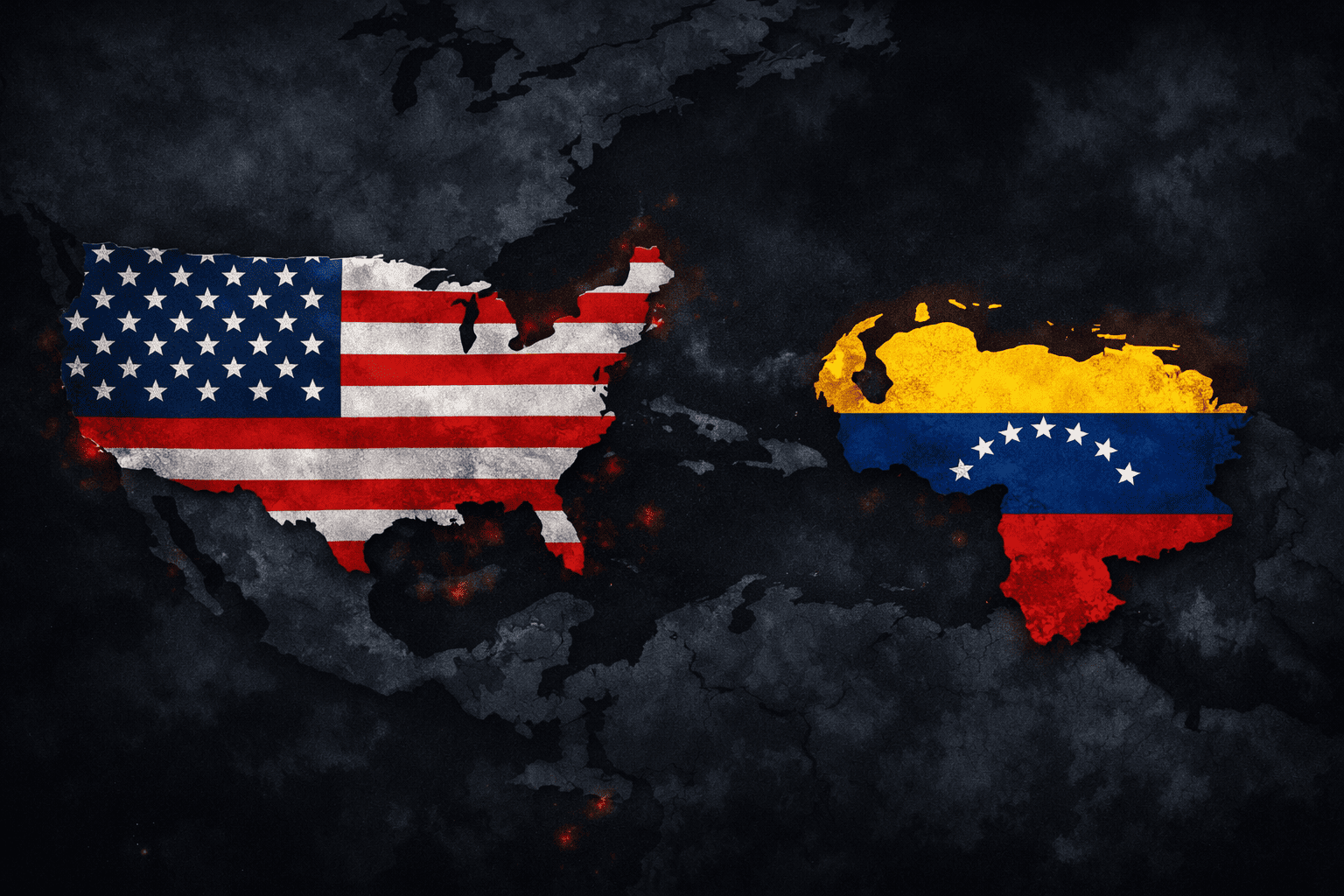
The contemporary conflict between the United States (U.S.) and Venezuela is best understood as the outcome of a long historical process shaped by the U.S. intervention in Latin America, strategic resource dependency, and recurring disputes over sovereignty and political legitimacy.
This blog lawsplains the U.S.–Venezuela relationship through distinct historical phases. Each phase builds upon the preceding one, making the present conflict intelligible only in its full context.
II. Early 20th Century: Interventionism and the Emergence of Oil as a Strategic Asset
The U.S., interest in Venezuela became pronounced during the 1902–1903 debt crisis, when European powers imposed a naval blockade to recover unpaid debts. In response, U.S. President Theodore Roosevelt articulated the Roosevelt Corollary to the Monroe Doctrine, asserting that the United States had the right to intervene in Latin American states to prevent European involvement. This doctrine formalised U.S. hegemony in the Western Hemisphere and normalised intervention as a tool of regional governance.
As Venezuela emerged in the early twentieth century as one of the world’s principal oil producers, U.S. economic interests deepened significantly. American oil corporations acquired extensive control over extraction and export operations, while successive U.S. administrations supported Venezuelan authoritarian regimes that prioritised political stability and favourable investment conditions. Thus, oil became the central axis of bilateral relations, binding Venezuela’s economic structure to U.S. strategic interests.
III. Cold War Alignment and Democratic Stability (1958–1970s)
After overthrowing the Pérez Jiménez dictatorship in 1958, Venezuela entered the so-called Puntofijo era of representative democracy. During the Cold War, successive Venezuelan governments aligned closely with U.S. anti-communist strategy, positioning the country as both a stable democratic ally and a reliable supplier of crude oil.
However, this period of apparent stability concealed significant structural vulnerabilities. Economic growth was heavily dependent on oil revenues, while social inequality and institutional fragility persisted beneath the surface.
- Nationalisation of the Oil Industry and the Creation of PDVSA: Venezuela’s oil industry was officially nationalised on January 1, 1976 under President Carlos Andrés Pérez. This nationalisation transferred control from foreign oil companies to the Venezuelan state and led to the establishment of the state-owned oil company PDVSA (Petróleos de Venezuela, S.A.). This company became responsible for exploration, production, refining, and export of Venezuelan oil, whilst becoming one of the largest state-owned oil enterprises in the world.
IV. Breakdown of the Political and Economic Order (1980s–1990s)
By the 1980s and 1990s, declining oil prices, rising foreign debt, and austerity measures severely destabilised Venezuela’s economy. The crisis reached a critical point in 1989 with the “Caracazo” riots, sparked by fuel price increases and economic liberalisation policies. The state’s violent response resulted in hundreds of deaths and permanently undermined public confidence in traditional political parties.
These events delegitimised the existing political order and generated widespread support for radical alternatives, setting the stage for systemic political transformation.
V. The Chávez Era: Ideological Rupture and Reassertion of Sovereignty
The election of Hugo Chávez in 1998 marked a decisive ideological break. Chávez declared Venezuela a socialist state and framed his policies as “anti-imperialist,” directly challenging U.S. influence in Latin America. He strengthened alliances with Cuba and Iran and pursued an assertive foreign policy aimed at reducing U.S. influence in Latin America.
During the presidency of Hugo Chávez, PDVSA remained state-owned but was increasingly integrated into the government’s political and social agenda. Chávez used oil revenues to finance social programmes and to build alliances within Latin America. The company’s autonomy was reduced as the government strengthened political control over it.
A critical rupture occurred following the 2002 coup attempt against Chávez, which his government alleged had received tacit U.S. support. The subsequent 2002–2003 PDVSA strike resulted in the dismissal of thousands of experienced managers and technicians, who were replaced with political loyalists. This severely weakened the company’s technical capacity and initiated a long-term decline in oil production.
VI. Oil as a Geopolitical Strategy and the Deterioration of Bilateral Relations
During the Chávez presidency, oil ceased to function merely as an economic commodity and was increasingly deployed as a geopolitical tool. Chávez diversified oil exports toward China, Russia, and regional allies, while also supplying subsidised oil to Caribbean and Latin American states through initiatives like Petrocaribe. Although oil exports to the U.S. continued, they were increasingly framed as a strategic liability rather than a partnership.
Thus, oil shifted from being an economic bridge to a geopolitical strategy.
- Maduro, Sanctions, and the Interim Government:
- Following Chávez’s death, Nicolás Maduro assumed power in 2013 amid deteriorating economic conditions. Continued mismanagement, corruption, and political interference further eroded PDVSA’s capacity, leading to a dramatic fall in production and revenues.
- The United States responded with a “maximum pressure” strategy, imposing sanctions on Venezuelan officials, financial institutions, and PDVSA itself, effectively restricting access to U.S. markets and international finance. In 2019, after declaring the 2018 presidential election fraudulent, the U.S. and several allied states recognised Juan Guaidó as Venezuela’s interim president, producing a dual-authority situation that paralysed governance and deepened international divisions.
- Under Maduro, Venezuela increasingly sought trading in other alternative currencies (like the Chinese yuan) for oil and strengthened ties with BRICS nations (Brazil, Russia, India, China, South Africa). Simultaneously, hyperinflation forced widespread domestic reliance on the U.S. dollar, creating a de facto dual-currency economy.
VII. 2024-2026: Electoral Disputes and Escalation
In 2024, Venezuela held another presidential election widely criticised for lacking fairness and transparency, resulting in Maduro’s continuation in power. Simultaneously, the United States experienced a major political shift with the re-election of Donald Trump as U.S. President in late 2024. His administration revived a hard-line approach towards Venezuela.
Throughout 2025, the U.S. increased military deployments in the Caribbean, intensified maritime interdictions linked to alleged drug trafficking, and seized Venezuelan oil assets. These actions peaked in early January 2026, when U.S. forces conducted a direct operation to capture Maduro, framing it as a law-enforcement action but provoking widespread international condemnation as a violation of sovereignty and international law.
VIII. Conclusion
This historical background demonstrates that the U.S.–Venezuela conflict is the cumulative result of interventionist precedents, oil-driven dependency, ideological confrontation, sanctions, and contested political legitimacy. A clear understanding of this historical trajectory is essential for any legal or geopolitical analysis of the events that unfolded in 2026 and their implications for international law, sovereignty, and global order.
REFERENCES
- https://time.com/7344628/us-venezuela-trump-maduro-oil-drugs-war-explainer-questions-answered/
- https://www.congress.gov/crs-product/R44841#:~:text=U.S.%20relations%20with%20Venezuela,%20once%20a%20major,the%20increasingly%20authoritarian%20Hugo%20Ch%C3%A1vez%20government%20(1999-2013).https://en.majalla.com/node/329019/politics/us-captures-venezuelas-president-maduro-how-did-we-get-here
- https://government.economictimes.indiatimes.com/news/defence/venezuelas-political-crisis-the-fall-of-maduro-and-the-rise-of-american influence/126365554#:~:text=The%20political%20crisis%20deepened%20in%202019%20with,backing%20from%20Russia,%20China,%20Iran,%20and%20Cuba.https://www.bbc.com/news/articles/crmlz7r0zrxo
- https://www.cfr.org/global-conflict-tracker/conflict/instability-venezuela
- https://www.npr.org/2026/01/02/nx-s1-5652133/us-venezuela-interventionism-caribbean-latin-america-history-trump
Leave a Reply